Should You Stake a Newly Planted Tree?
How to Decide and Do It Safely
A new tree does not always need stakes
It is tempting to stake every tree after planting, but support is not automatically helpful. A tree that stands upright with a stable root ball often establishes better when it can move naturally in the wind. Gentle movement encourages the trunk to strengthen. Holding the tree rigid can limit that development, and ties left in place too long may rub or constrict the bark.
Staking is a temporary tool for specific situations. It may be appropriate when the root ball shifts, a tall or bare-root tree cannot remain upright, the planting site is unusually exposed, or the tree has an unbalanced canopy. Decide based on the tree’s stability after planting, rather than assuming every trunk needs a brace.
Check stability before installing support
After the tree is positioned and the hole backfilled, gently move the trunk. Watch the root ball and soil at the base. If the trunk flexes while the root ball stays firmly in place, the tree may not need stakes. If the root mass rocks or the tree leans significantly, temporary support can help while roots grow into surrounding soil.
The tree’s size, nursery stock and planting conditions matter. Container-grown, balled-and-burlapped and bare-root trees have different root configurations. Loose soil, a steep slope or persistent wind may make support more useful. A very large tree should be planted and supported according to its size and equipment requirements; improvised stakes and ties can fail under heavy movement.
Planting correctly is the first step
Staking cannot compensate for a poorly planted tree. Set the root flare at or slightly above finished grade, ensure the hole is broad enough for roots, and backfill with appropriate soil. Water to settle the backfill and remove large air pockets without packing the soil hard. If the tree sits too deep, has circling roots or is planted in a waterlogged location, correct those issues before adding straps.
Keep mulch in a broad, modest layer over the root zone and away from the trunk. Do not bury the flare. Water the tree through dry periods during establishment. A correctly planted tree with a stable root ball has the best chance of standing on its own, reducing the need for support.
Choose the right stakes and placement
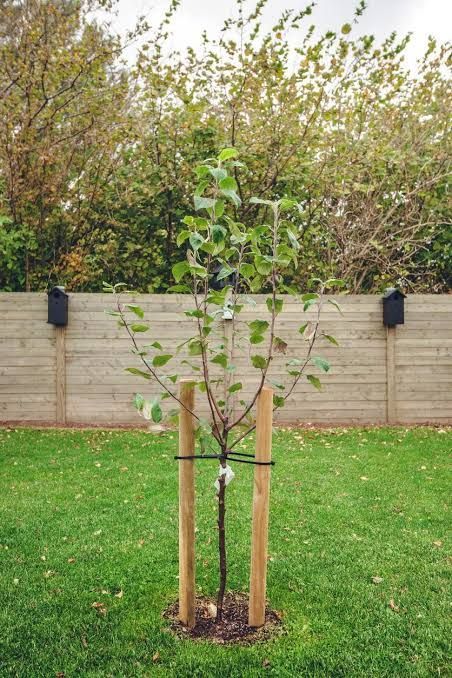
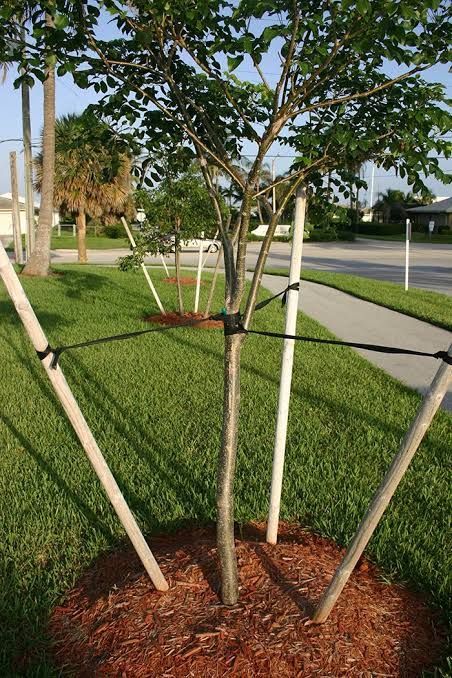
When staking is necessary, two stakes placed on opposite sides of the tree often provide balanced support. Drive them into firm, undisturbed soil outside the root ball, not through the roots. The exact setup depends on tree size and site exposure; very windy or unusual sites may need a different arrangement. Stakes should be secure enough to support the tree without becoming a hazard in a walkway or lawn.
Use wide, flexible tree ties designed for the purpose. They distribute pressure better than wire, fishing line, thin rope or narrow twine. Attach the ties low enough to allow the upper trunk to flex, but high enough to steady the root mass. A figure-eight arrangement can keep the trunk from rubbing directly against the stake or tie.
Allow some movement
The purpose of staking is to prevent the tree from uprooting or leaning excessively, not to eliminate all movement. Leave enough slack for natural sway while keeping the root ball stable. A trunk that cannot move at all may not develop as strong a lower stem, and restrictive ties can injure bark as the tree grows.
Inspect the setup after wind and rain. Tighten or reposition ties if the tree has shifted, but do not cinch them against the bark. Check for abrasion, leaning, loose stakes and soil movement. If support is not keeping the tree upright, reassess planting depth and root-ball stability instead of adding more tension.
Remove the support on time
Stakes and ties should be temporary. Check the tree during the growing season and remove the supports once the root ball is stable and the tree can stand upright. Many landscape trees need support for less than a year, but the correct timing depends on species, size, root condition and exposure. Inspect at least monthly so ties do not begin to cut into the trunk.
Leaving stakes attached indefinitely can create several problems: the trunk may remain weak, ties can girdle or scar it, and equipment or mowing can catch the supports. Do not rely on a date alone. Gently test stability and remove support when the tree no longer needs it. If it still rocks after a full growing season, inspect the root zone and planting conditions.
Common staking mistakes
The most common mistake is staking a tree that is already stable. Other errors include driving stakes into the root ball, using wire or narrow cord, placing ties too high, pulling them too tight and forgetting to remove the system. One stake can also allow the trunk to pivot around the support instead of keeping the root mass steady.
A tree leaning after planting may need to be reset, not simply pulled upright with a tight tie. A root ball that is tilted or planted too deep should be corrected before support is installed. If a tree is large, valuable or positioned on a steep slope, ask a qualified professional to assess it rather than experimenting with hardware.
When professional help is useful
Some situations require more than two stakes and a strap. Large-caliper trees, loose or saturated soil, steep grades, exposed corners and trees that repeatedly lean need a careful evaluation. A professional can assess the root ball, soil, site wind and planting depth, then decide whether staking, guying or replanting is appropriate.
If you are scheduling a tree planting service in Oakland County MI, ask how the crew evaluates stability and what support, if any, will be used. Confirm how ties will be checked and when they are expected to come off. A good installation should include planting depth, watering and aftercare instructions, not just a tree secured with stakes.
A strong tree needs room to establish
The best support is often no support when the tree is stable, planted correctly and suited to the site. When staking is needed, use a flexible system that steadies the roots but permits trunk movement. Inspect it regularly and remove it as soon as the tree can support itself.
- That simple approach helps avoid bark damage and encourages a stronger, more self-supporting tree. A few minutes spent checking the root ball and ties can protect a planting investment for years, whether the tree is a small ornamental in a front bed or a larger shade tree in an open yard.
For more articles on landscaping, garden maintenance, and hardscaping, click here.
Southfield Landscaping serves homeowners and businesses with lawn care, hardscaping, drainage, and year-round property care. We offer Lawn Care services to help you build the outdoor space of your dreams.